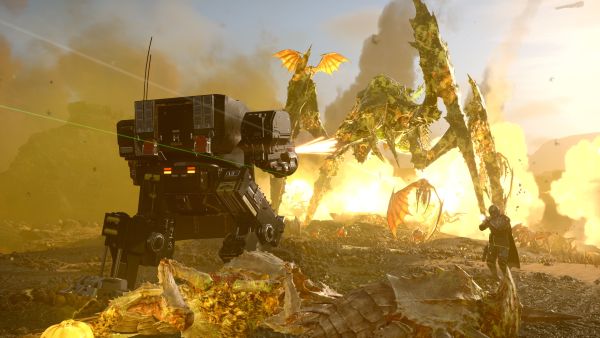
Co-op gaming has a structural problem that nobody really talks about: most of the genre's coolest moments happen in private. Two friends pulling off a flawless boss kill in a four-player raid, a hilariously bad Lethal Company run that ends in everyone screaming over voice chat, the perfect Helldivers 2 extraction — these are amazing experiences for the people in the lobby, and almost completely invisible to anyone outside it.
Live streaming entertainment figured out how to solve that problem fifteen years ago, and most co-op games still haven't borrowed the lessons. There's an entire toolkit of audience-facing features that streamers and live-event platforms have refined into something genuinely sophisticated, and co-op game design is mostly ignoring it.
The clearest example of where this gap hurts is in the comparison to live dealer gaming, which has built some of the most sophisticated low-latency interactive streaming infrastructure that exists. A modern live casino guide breaks down platforms running multi-camera HD streams with sub-300ms latency, real-time chip placement that synchronizes with on-screen action, and chat integration with the dealer that maintains conversational flow.
A typical Evolution Gaming or Pragmatic Play Live blackjack table now offers viewers four-to-six camera angles, picture-in-picture for side bets, dealer-cam plus table-cam composite views, and bet-slip overlays that update in real time across thousands of concurrent viewers.
The category had to solve harder technical problems than co-op gaming faces because the stakes were financial, but the solutions are now well-documented and increasingly cheap to license. There's no good reason a co-op game in 2026 should have worse spectator infrastructure than a blackjack table.
The asymmetric-audience problem
The fundamental design tension in co-op gaming is that the experience is built for the players, but the audience for it is much larger than the player count. A great Deep Rock Galactic squad has four people inside the game and could potentially have hundreds of viewers outside it on Twitch — friends watching, fellow players studying strategies, content audiences who never play themselves but love watching co-op chaos.
Most co-op games don't acknowledge this audience exists. Spectator modes are afterthoughts when they exist at all. Replay tools are usually missing. Stream-overlay integration ranges from bad to nonexistent. The genre treats every session as if the only people who matter are the four to eight in the lobby.
Live streaming has a much more sophisticated mental model. A music event isn't just for the people in the venue — it's also for the live audience watching from home, the timeshifted audience watching the recording, the highlight-clip audience consuming short-form derivatives, and the discussion audience reading reviews and reactions afterward. Each of those audiences gets considered in how the event is structured.
What's already working in adjacent industries
The platforms that have figured out audience-aware live experience design come from outside co-op gaming entirely.
Live music streaming has solved multi-camera direction, intelligent crowd-cam cuts, and synchronized chat-based reactions. Watching an Amazon Music Live concert from home is a meaningfully designed experience, not just a single fixed-camera feed.
Esports broadcasting has developed observer cameras that follow the action better than any player POV could. A good observer can make a 10-player Counter-Strike round comprehensible to a viewer who's never played the game. Co-op games have nothing equivalent — try watching a four-player Phasmophobia stream from outside, and you'll see how confusing it gets without good camera direction.
Live entertainment infrastructure more broadly has matured to the point where the streaming-tech stack used in casinos, music platforms, and esports broadcasts is now off-the-shelf-licensable. The technical barrier that used to keep this kind of infrastructure expensive has dropped substantially in the past three years.
Specific things co-op games could steal
Three concrete features that live streaming and live entertainment have proven work, and that co-op games could implement without massive engineering investment.
Director cameras. A spectator-mode camera that automatically prioritizes the most interesting player based on what's happening — combat, near-death, key objective progress. Esports broadcasting has refined the algorithms for this, and live dealer studios use a simpler version of the same logic when their software auto-cuts between the wheel-cam and the dealer-cam at the moment the ball drops. Co-op games could implement watered-down versions easily.
Highlight auto-capture. When something significant happens in a co-op session — a team kill, a clutch revive, a session-ending failure — the game should automatically capture a 30-second clip that can be exported. Twitch streamers do this manually with countless tools. Live dealer platforms already auto-capture every winning hand above a certain threshold for compliance and replay reasons. Co-op games could just bake the same logic in for memorable moments.
Asynchronous viewership. A way for friends to "watch" a previous session of yours and chat about what happened, even if they weren't there live. Replay-with-chat has been solved by streaming platforms for years.
What this would actually unlock
The reason this matters isn't just better content for streamers. It's that co-op gaming's natural audience is much larger than its current player base, and the genre has been missing huge growth opportunities by not capturing it. People who would never play Phasmophobia themselves love watching their friends play it. The barrier between player and audience in co-op gaming is mostly artificial — a design choice that hasn't been revisited since the genre emerged.
Games that have invested in audience-facing infrastructure have seen the payoff. Among Us became a phenomenon partly because its mechanics are extraordinarily watchable. Lethal Company topped Twitch's most-watched games charts for weeks at a time before it had a comparable player base, because clip culture made it impossible to ignore.
As we covered in our piece on the rise of social co-op games and their broadcasting potential, the games that scale to mainstream success in the streaming era tend to be the ones that work as well in highlight clips as they do in 40-minute sessions.
The harder design question
There's a real tension here that good co-op design has to navigate. Some of the magic of co-op gaming comes from the privacy of the experience — the inside jokes that wouldn't translate, the bad strategies that work because nobody else is watching, the comfort of playing with friends without performing for an audience.
Designing for spectator-friendliness without compromising that intimacy is the actual problem. The answer probably looks more like opt-in audience features than full default-on broadcasting. Players should choose when their session is shareable and when it's not. The infrastructure should be there; the activation should be voluntary.
Where this goes
The co-op games that emerge over the next few years are going to have to take the audience-side of the experience more seriously than the genre has historically. Streaming platforms aren't going away, content audiences for gaming aren't shrinking, and the gap between what live entertainment infrastructure can do and what most co-op games actually offer is just getting wider.
Borrowing from the playbook that music streams, esports broadcasts, and live dealer platforms have already written is the obvious move. The infrastructure for high-fidelity interactive streaming is no longer the moat it was five years ago — if a live dealer studio can run a blackjack table with sub-300ms latency, multi-angle composition, and synchronized chat for thousands of concurrent viewers, a co-op game studio can absolutely afford to bring half that polish to the spectator side of a Helldivers 2 session.
The hard part isn't figuring out the features — it's getting the design philosophy right so the audience layer enhances the player experience rather than constraining it. Co-op gaming has been a brilliant genre for almost two decades. The next decade will be defined by which games figure out that the audience watching has always been part of the fun.


