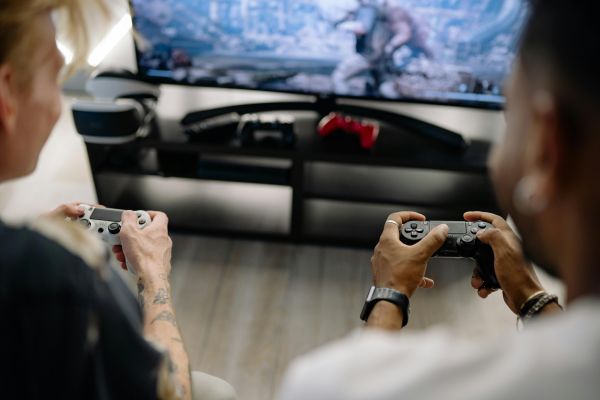
Someone goes down at the worst possible time. One player panics, someone else hits the wrong button, and suddenly the whole run is hanging by a thread. You either recover at the last second or wipe and start again, usually laughing about it before the restart even loads.
That’s always been the draw of co-op. Not getting everything right, just those shared moments that don’t quite go to plan. Even as games have shifted toward live-service models and constant updates, that part has not really changed. If anything, it is easier to jump into now than it used to be.
From Couch Co-op to Always-Online and Back Again
Co-op has not disappeared; it has just stretched. What used to mean two people on the same screen now covers online sessions, crossplay and drop-in systems that do not need much setup. You can play from the same room or across different platforms without it feeling like a completely different experience.
Games like It Takes Two still build everything around playing together in the same space, forcing players to constantly rely on each other. On the other end, something like Helldivers 2 leans into online coordination, where things rarely go smoothly. Half the time, the chaos is the point. It is also much easier to get going. You do not need to block out an evening or organize anything in advance. If a couple of people are around, you jump in and see how far you get.
Why Playing Together Still Hits Different
There is a difference between playing alongside other people and actually depending on them. Co-op sits firmly in the second category, and that changes how every moment feels.
You notice it in the small things. Someone mistimes an ability, and it throws everything off. A missed jump resets the whole section. Or the opposite, a last-second save that somehow keeps the run alive when it should have ended.
Those moments do not really happen the same way in solo play. Solo runs tend to be predictable. Competitive matches focus on winning. Co-op lands somewhere else, where success depends on how well you adapt to other people as much as the game itself. That unpredictability is what sticks. Even when things go wrong, those are usually the moments people remember. It gives co-op an edge you do not really get elsewhere.
The Loops That Keep Co-op Groups Coming Back
Co-op has taken on a lot from modern design without losing what makes it work. Short sessions, repeatable objectives, shared progression. Even a quick run can feel worthwhile if something moves forward.
That matters more now. Not every group has time for long sessions, so systems that work in shorter bursts are easier to return to. A small upgrade or unlock can be enough to keep people engaged.
It shows up in the numbers as well. Co-op games generated around $8.2 billion on Steam in 2025, according to Alinea Analytics. Numbers like that do not come from a small audience. They reflect how consistently players return to shared experiences.
Many of the biggest releases in recent years have leaned heavily into co-op design, which reinforces how central shared play has become. Players are not just trying these games; they are staying with them over time.
Why Structure Matters More Than People Think
When you are playing co-op, unclear systems stand out straight away. If progression feels inconsistent or rewards do not line up, it affects everyone, not just one player. Confusion spreads quickly when players are relying on each other.
Structure ends up mattering more than it seems at first. Players need to understand what they are working toward and how it fits into a session, especially when timing and coordination matter. That kind of clarity becomes more important as players move between different types of digital experiences, especially in regulated US markets like Pennsylvania, where everything is designed to be transparent and consistent.
Once you get used to that, it is hard to go back to something that does not make sense. That is why resources like Casino.org for a range of platform comparisons come up when people start looking at other formats. Casino.org focuses on regulated US markets, including Pennsylvania, breaking down how licensed platforms work and what players can expect. For players coming from co-op games, that level of consistency feels familiar.
Fair Systems Keep Players Around
Co-op only works if players trust what is happening. If something feels off, whether it is balance, rewards, or outcomes, people stop coming back. That trust comes from consistency more than anything else. The same idea applies elsewhere. In regulated environments, systems are built to behave predictably, which is part of why players are more comfortable using them.
In New Jersey, online gaming revenue reached around $2.39 billion in 2024, according to the New Jersey Division of Gaming Enforcement, with total gaming revenue across all channels hitting roughly $6.3 billion. Those figures point to setups where players feel comfortable returning because the way things run is clear.
From a co-op perspective, it is the same idea. If things behave the way players expect, they stay. If not, they move on.
Co-op Is Not Going Anywhere; It Is Just Evolving
Co-op is not replacing anything. It is adapting alongside everything else. Sessions are shorter, setups are easier, and it is simpler to jump in and out without losing progress.
What has not changed is why people play this way in the first place. You are still relying on other people, still reacting to mistakes, still pulling things together at the last second.
It is not just the game itself; it is what happens between players while you are trying to get through it. Solo runs can be polished. Competitive matches can be precise. Co-op is unpredictable in a way that makes every session feel different. That is a big part of why it still works. Not because it is trying to be better than everything else, but because it offers something the others do not.


