
Beyond the Co-Op Couch: Why Kiwi Gamers Are Adding Live Dealer Tables to Friday Night Rotation
Image: Live Dealer Shuffling Cards | Shutterstock
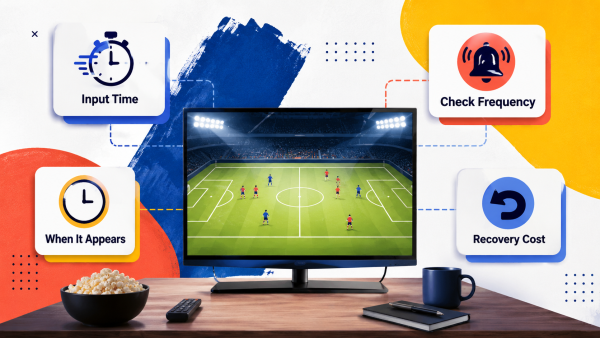
Image source: Illustration by the author
A watch-party activity should create a reason to talk, laugh, and compare choices without turning every quiet moment into another task. The easiest mistake is choosing an activity because it looks engaging on its own. During a live match, the better question is how much attention it takes, when it asks for that attention, and how difficult it is to return to the action afterward. A five-second choice before kickoff behaves very differently from a quiz that keeps demanding answers while play continues.
That distinction matters because second-screen use is already part of sports viewing. A Frontiers in Sports and Active Living study describes second-screening as using another device alongside the television, often for messages, discussions, videos, or additional sports information. It also notes that the television generally remains the main viewing medium for most audiences. For watch-party organizers, that makes the television the fixed point and the phone a temporary tool rather than a competing attraction. The phone should support that shared focus.
A useful way to judge second-screen activities is to give them an interruption budget. That budget has four parts: how long each action takes, how often players must respond, when those actions occur, and how much effort is needed to understand the match again after looking away.
For a real-world example, Lucky Rebel has a broad homepage covering sports, casino, live casino, and a collection of football-themed games. Many of these are suitable for short moments of engagement before the match, or during breaks and halftime. What’s more, its sports coverage offers information about what’s going on and how the match is unfolding.
You can also get an understanding of how match predictions might work by checking out the page’s social media content – for instance, this video covers the A or B prediction setup for each tournament match. A single binary choice has a small input cost because the viewer does not need to enter an exact score or select several outcomes. The interaction finishes before it becomes a parallel task. Of course, its timing still determines whether it stays unobtrusive. A choice made before kickoff or between matches leaves the live action alone, while the same task during active play could pull attention elsewhere.
**PLEASE EMBED THIS LINK**
https://www.youtube.com/watch?v=JOAUjln9B5Y
The video also uses a continuing streak, so players need to remember their progress across fixtures. That adds continuity without requiring constant interaction, provided the rules and next action remain easy to check. The lesson is broader than one campaign: short inputs help, but predictable timing and simple recovery matter just as much.
The lowest interruption cost comes from a single-choice match call. Everyone makes one selection before kickoff, then leaves the phone alone until the next fixture or break. An A/B call works well because it gives the group something to compare without asking anyone to enter a scoreline, check player data, or keep returning to the screen while the match is moving.
A score-prediction sheet creates deeper post-match discussion, but it also asks for more attention. Even a simple 2-number entry can slow the room down if people are still deciding after coverage has started. This format works best when everyone completes their picks before kickoff and agrees not to reopen the sheet until halftime or the final whistle.
A group poll is useful when the question is quick and social: who scores first, which team starts stronger, or whether the match reaches extra time. The poll should close before play resumes. If the question stays open during active play, people begin watching the responses instead of the match.
A short football quiz belongs at halftime, not during open play. Keep it to 5 or 6 familiar questions and avoid timed rounds once the players are back on the pitch. The quiz should fill a natural pause, not compete with a counterattack, replay, or disputed decision.
Fantasy updates and stat-heavy companion games have the highest recovery cost. Checking lineups, transfers, live tables, or detailed player numbers can pull someone into a separate task for several minutes. Save those activities for before the broadcast or after the final whistle.
Recovery cost is easy to overlook. Looking away for 5 seconds during a stoppage may cost nothing. Looking away for the same period during a counterattack may leave someone asking who lost possession, how the chance developed, or why the crowd reacted. The clock time is identical, but the viewing cost is not.
A second-screen game becomes distracting when it keeps asking viewers to return their attention to it. One selection before kickoff is usually fine, but repeated questions can turn the phone into a competing broadcast. Count how many checks an activity requires during the match.
The cleanest formats collect decisions at once. A group can complete its match calls before coverage begins, close the page, and compare answers later. Polls and quizzes need firmer boundaries because notifications, countdowns, and live totals encourage repeated checking after an answer is submitted.
Remote groups need a clear stopping point. Give everyone time to respond, then have one person confirm that choices are locked.
A PLOS One study on second-screen messages found that tablet content drew attention away from a television broadcast. Although the study examined news rather than football, its practical lesson still applies: once everyone has responded, the phone should become quiet, and the match should regain attention.
Image: Live Dealer Shuffling Cards | Shutterstock

Gaming and gambling appear to be popular in Canada. When asked how much they spend per month on those pastimes, Canadians reported an average of $6.75.

Live dealer casino is not usually discussed as a form of multiplayer game design, but structurally it is exactly that. A dealer runs a game in real time from a studio, several players observe the same game state through a video stream, and everyone can chat while play unfolds. Take away the money and the format is recognisable to anyone who