
Online games do not feel human because they have chat boxes. They feel human when someone is present enough to change the pace of the session. A teammate calling a move at the right second, a streamer reacting to a party wipe, or a host guiding a group through the next round can turn a screen into a shared room for everyone involved.
A useful way to read this is through timing. In a Frontiers in Psychology study of cooperative multiplayer teams, players adjusted their communication as visibility changed, using conversation to keep the group aware of the situation. That maps cleanly onto co-op play: the more a session asks players to read one another, the more every pause, callout, laugh, and correction starts to matter.
Hosted Play Gives the Session A Pulse
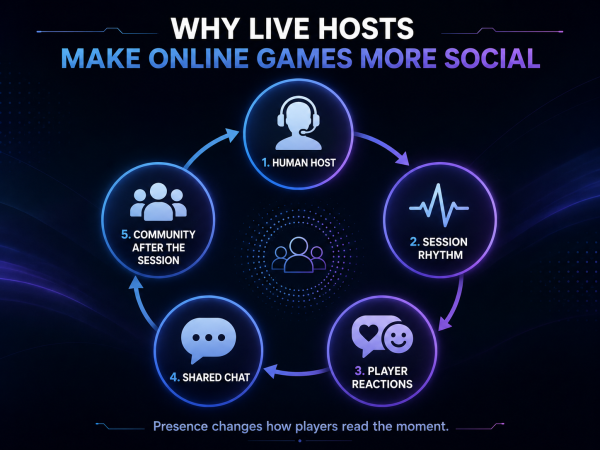
Live-hosted formats make that easier to see because the person running the moment is visible. A dealer, guide, moderator, streamer, or team leader gives players a focal point that automated systems rarely provide. We can see this a lot in live casino games, which hinge upon ensuring players know exactly what is happening at a given moment, and ensuring everyone stays engaged. Casinos will hire highly-skilled professionals to serve in these roles – people who know precisely how to manage the setup with aplomb and keep the game flowing.
In particular, Cafe Casino’s live dealer page is a direct example of this kind of hosted online play: players can play live dealer games with real hosts streamed to the screen, with live blackjack, roulette, and baccarat on offer. Within these games, they’ll find that table action, camera views, and chat constantly shape the pace of the session, but in particular, the dealer serves as the focal point. Their actions give the table rhythm, while the chat gives players a light social thread running alongside the action. That is the same reason a good raid caller, puzzle partner, or party host can make an online session feel easier to follow.
The surrounding community layer matters as well. This Discord post points to the space around the session, where chat, updates, events, and giveaways keep people connected between visits. Gaming communities already work this way. The session gives players something to do together; the outside channel gives them somewhere to talk, return, and keep track of what is happening next.
Co-Op Players Already Know the Feeling
Anyone who plays co-op games has felt the difference between a technically full group and a group that actually feels present. Four silent players can clear a mission and still feel disconnected. Two players with good timing can make a smaller session feel warmer, sharper, and more memorable. Having at least one good communicator acting in a host-like role can improve the whole session.
Often, if the game begins to slow down or people lose their focus, the host will be responsible for drawing their attention back to the screen. Of course, they don’t need to (and shouldn’t) dominate the experience. In many sessions, the best human presence is light but clear: a reminder, a callout, a reset, a small reaction that tells the group what just happened. The more readable the moment becomes, the easier it is for players to stay with it. Watching how hosts of live casino games handle this can make it easier to spot in other contexts too.
Presence Is More Than Voice Chat
Within a game, voice chat can be helpful, but presence requires something more. It often includes visible action, predictable pacing, readable reactions, and the sense that someone is attending to the same moment you are. A player who never speaks can still feel present through smart positioning, quick revives, or steady support. A host can feel present by keeping the session moving, without turning every action into commentary.
Players rarely recall only the objective. They remember the friend who said “hold on” just before the trap went off, the party leader who kept a messy run calm, or the streamer who made a failed attempt worth laughing about. The mechanic gives the moment structure. The person gives it texture.
Hosted play also makes waiting feel different. A pause between actions can feel empty when nothing is happening, but it can feel intentional when someone is holding the room. You’ve only got to engage with a game of baccarat to know what we mean here – that slight pause before the cards are turned, the deliberate moment of building anticipation... it’s crucial for making a live game feel right.
Co-op games with downtime, puzzle-solving, room codes, matchmaking, or spectator moments all benefit from that kind of attention. The player is not simply waiting for the software to advance. They are waiting with people.
Why The Human Layer Keeps Spreading
Online play keeps moving toward spaces that feel closer to gathering than logging in. Stream recaps, Discord groups, co-op events, live-hosted sessions, watch parties, and drop-in multiplayer games all solve different problems, but they share one trait: they give players more human context around the act of playing.
That does not mean every game needs a host. Some games work best when players disappear into systems, builds, routes, and personal mastery. Human presence matters most when the experience depends on timing, trust, explanation, shared attention, or reactions that happen in the moment.
The clearest co-op sessions have always worked this way. Players remember who spoke, who noticed, who hesitated, who recovered, and who made the session feel worth staying in. Hosted online play simply makes that pattern easier to spot. Digital play becomes more memorable when the screen stops feeling like a closed system and starts feeling like a place where people can read each other in real time. Co-op games are all about the connections they build, and there’s no question that having a skilled communicator, whether they are the official host in a poker game who makes everyone feel welcome, or just your best high school friend who’s got a gift for making people laugh, is the key to this.


